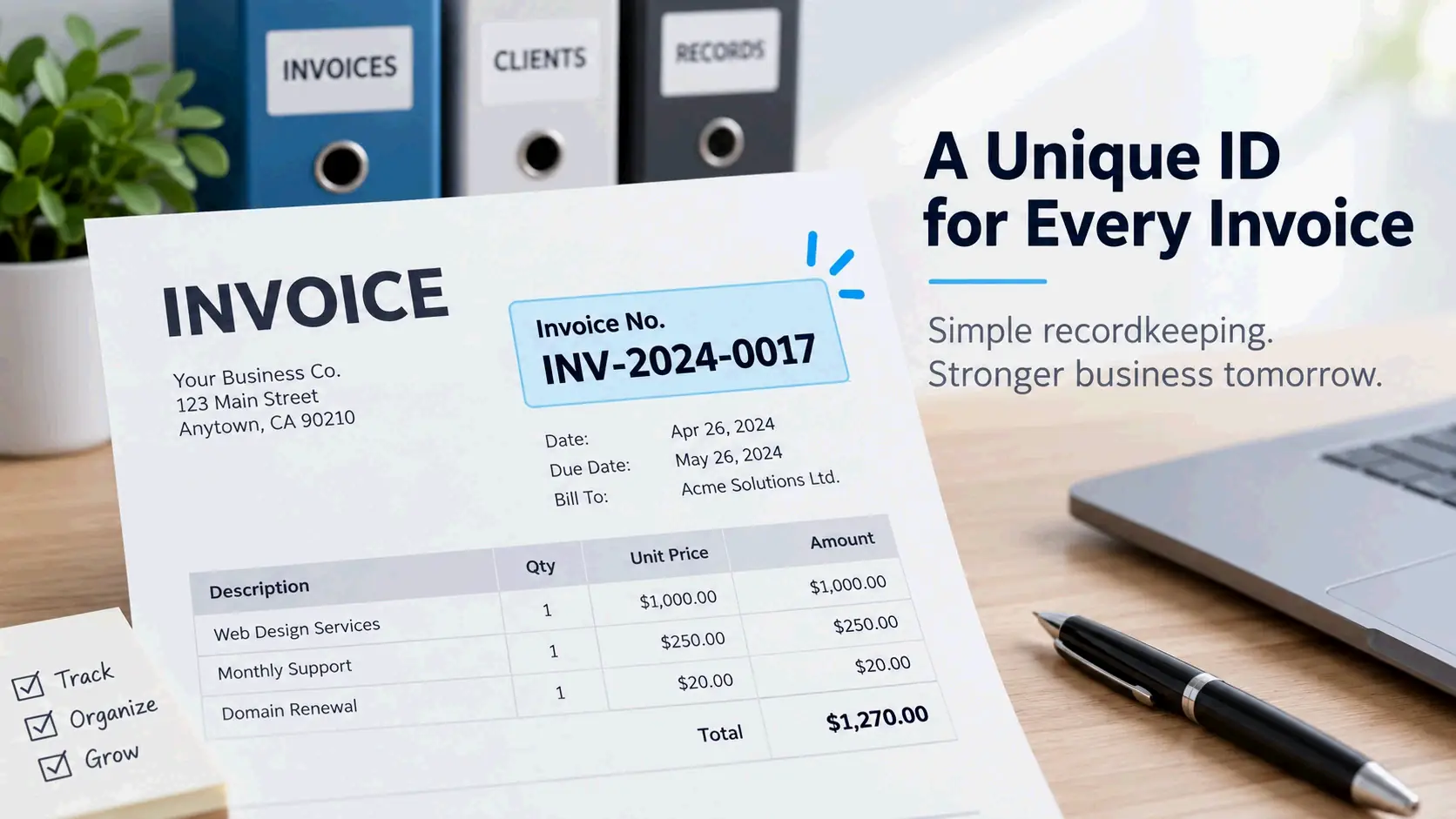
Invoice numbers explained: an invoice number is a unique ID assigned to every invoice you issue. It tracks payments, reconciles records, and keeps you audit-ready. Never reuse, skip, or delete one. The US sets no federally mandated format — but IRS recordkeeping rules still apply.
What Is an Invoice Number? (And What It Is Not)
An invoice number is the unique identifier assigned to one specific invoice you issue. It exists so that you, your customer, your bookkeeper, and a tax authority can locate the same transaction without relying on names, dates, or amounts that repeat constantly across a set of books.
In practice, the invoice number is the primary key of your accounts receivable ledger. When a customer’s payment lands with a memo line, the characters in that memo are the only thing that reliably ties the cash to the invoice it settles. Statrys describes the number as the reference that lets you locate and verify any specific transaction.
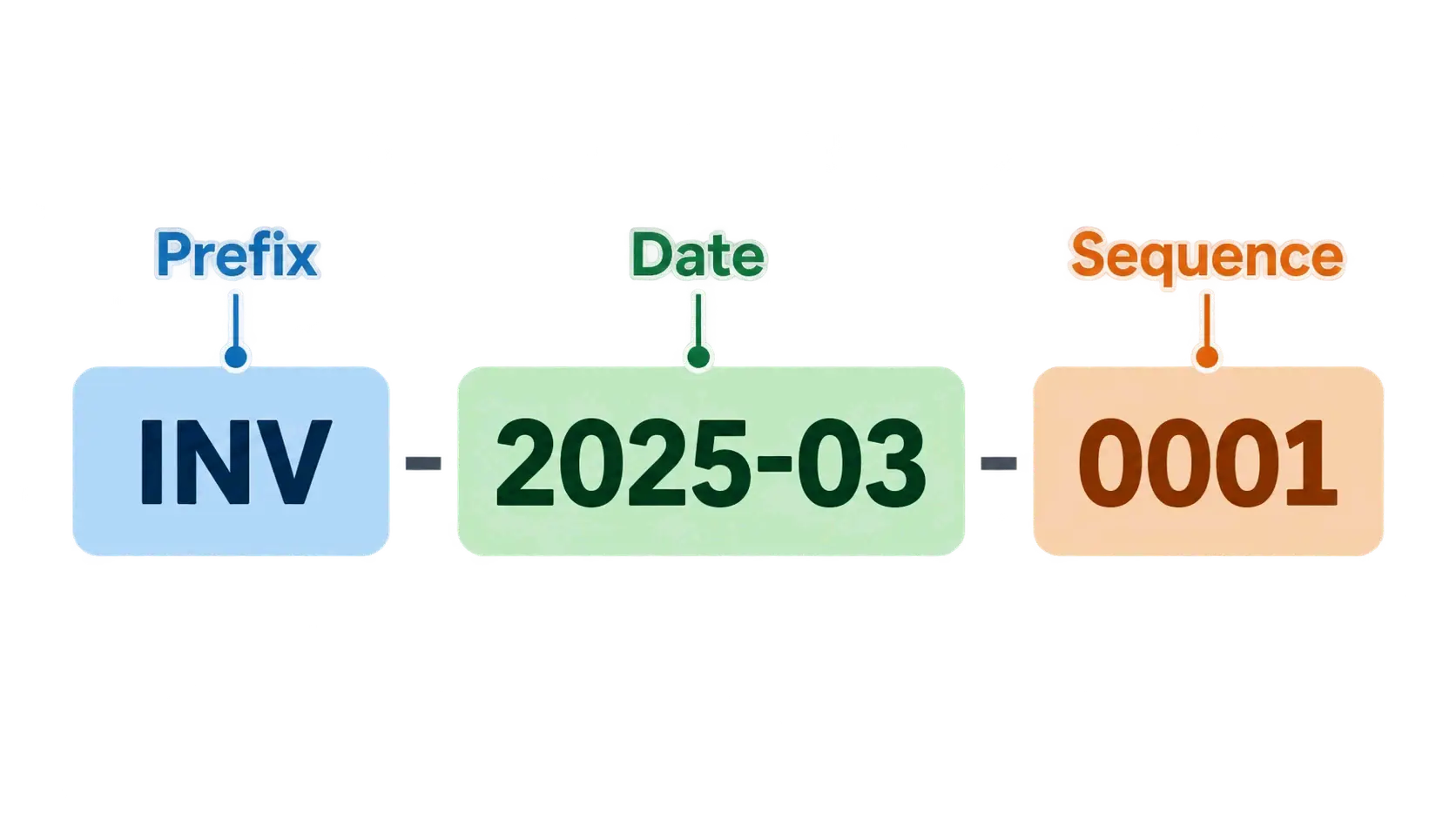
Every invoice number comes down to three components: a prefix, a sequential number, and optionally a date segment, plus zero-padding to keep the digits consistent. The format itself is yours to choose. Uniqueness is not. As Lev Tretyakov, CEO of Fortador USA, puts it: “We always include an invoice number for all sales we make. The invoice number makes it easy to pull up the transaction and provide accurate assistance to our clients.”
It also helps to know what an invoice number is not. It is not a purchase order number, a quote number, a receipt number, or a credit note number. Each of those is issued by a different party, at a different point in the transaction, for a different purpose.
The short version: numbering is an internal control, not an aesthetic decision.
The Three Parts of Every Invoice Number
A prefix identifies the document type or issuing entity, such as INV for a sales invoice or a branch code in a multi-location business. A date segment places the invoice in the right tax period, which speeds up retrieval during a review. The sequential number is the part that carries the control — it must increase logically and never repeat. Statrys recommends starting at 0001 rather than 1 so the sequence accommodates growth without a mid-year format change.
Where the Concept Came From: From Clay Tablets to Internal Controls
Numbered commercial records are not a modern invention. Around 5,000 years ago, merchants in ancient Mesopotamia used cuneiform script on clay tablets to document trade transactions, including quantities, prices, and the parties involved — and roughly 85% of the cuneiform tablets uncovered at Uruk (3000 BCE) represent economic records, according to Wikipedia’s overview of invoicing. Standardized printed invoice forms emerged with the printing press in the 15th century, and printed invoices with company names and logos were widespread by the 19th century. Digital and automated numbering systems followed in the 20th and 21st centuries.
The One Rule of Invoice Numbering: Never Reuse, Skip, or Delete
If you remember one rule from this guide, make it this one: one number maps to one invoice, once and only once. Every serious source on the topic converges on the same principle, and almost every numbering problem traces back to violating it.
A gap in the sequence is not automatically wrong, but an unexplained gap is a problem. During an audit or an internal review, a missing number raises a specific question — was there an invoice here, and if so, where did it go? Alaan notes that gaps are acceptable only when voided invoices are clearly documented; otherwise the sequence looks incomplete.
Reusing a number creates a different failure. If two transactions carry the same identifier, a payment that arrives against that number cannot be matched to a specific invoice, and the ambiguity persists in the ledger indefinitely.
This is why numbering matters beyond bookkeeping mechanics. A continuous, explainable, traceable sequence is itself evidence that your reported revenue is complete. Statrys points out that gaps or duplicate numbers raise questions about whether all income was reported, which matters more if your books are ever reviewed.
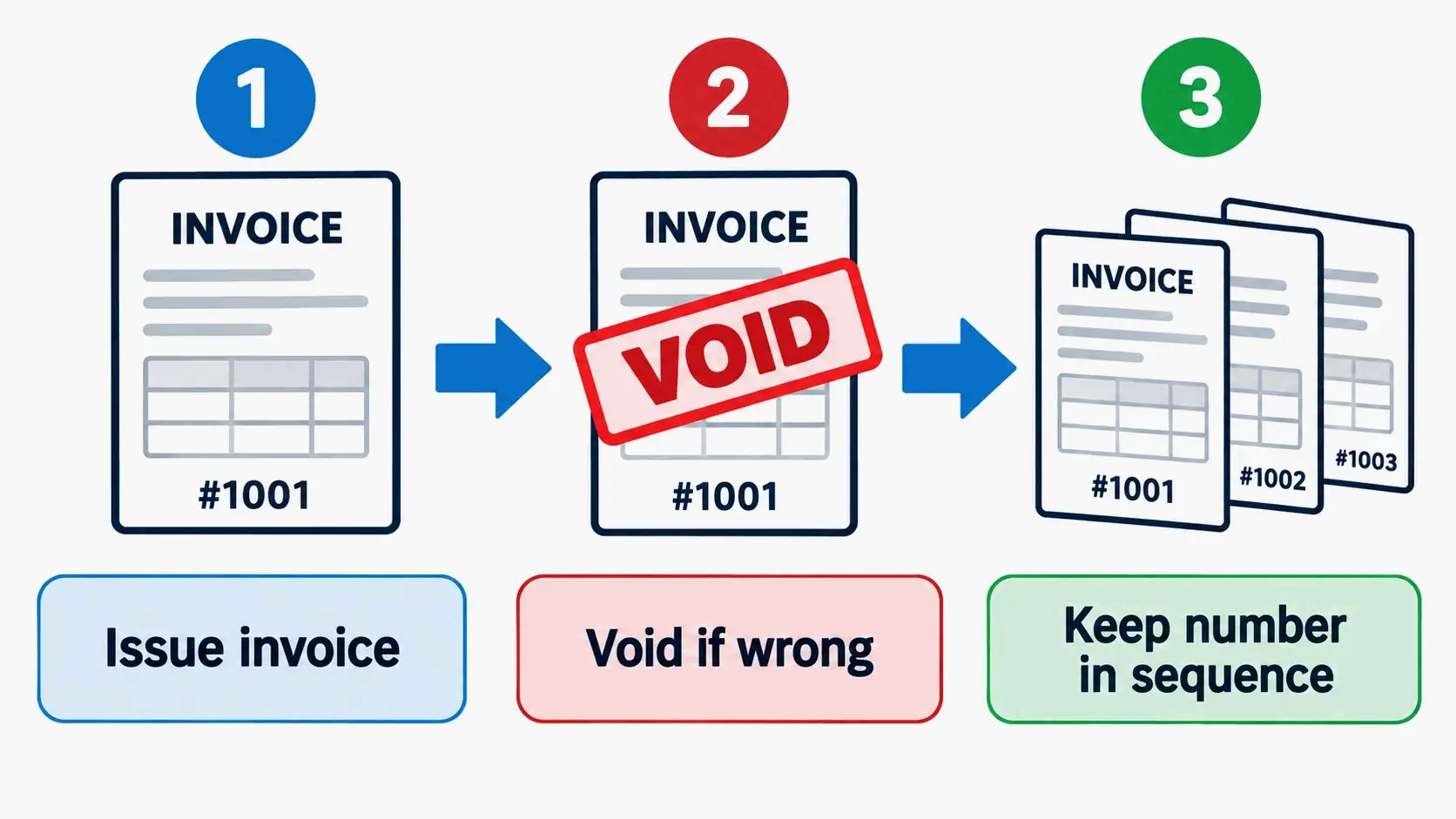
The operational rule that follows is simple: when an invoice is wrong, void it rather than delete it. Keep the number, mark the document void, and note the reason. The number stays in the sequence permanently, even though it will never produce a payment.
There is a second baseline rule that keeps your numbering aligned with reality. Lilach Bullock uses a fixed rule of invoicing within 24 hours of work being completed or a milestone being hit, with no exceptions and a calendar reminder attached. That discipline keeps the sequence order identical to the order in which business actually happened.
Why a Missing Invoice Number Triggers Questions
A missing number forces anyone reviewing your records to search by customer name, amount, or date instead of by a key. That search is slower and less precise, and it can end in a dead stop. Statrys frames the practical cost this way: when a client references a past transaction, the invoice number is what matches it to a record, and without one you rely on memory or manual searching. Multiply that across several clients and the gap becomes genuinely difficult to resolve.
Does the IRS Require Invoice Numbers? What US Rules Actually Say
Here is the answer most US readers are looking for: there is no federal requirement governing invoice number format, prefix, starting value, or continuity. Statrys states plainly that there is no legal requirement in the US to use a specific invoice number format, and no single federal requirement that invoice numbers be strictly sequential — though sequential numbering is standard practice and the default in most accounting software.
But “no mandated format” is not the same as “no recordkeeping requirement.” IRS Publication 334 (Tax Guide for Small Business) sets out the general record-keeping standards that apply to small business income documentation. An invoice number is what lets those records tie to each other — it is the thread that connects a payment to a sale to a reported figure.
Retention is the next layer. Ramp notes that the IRS and most tax authorities require keeping invoices for at least three to seven years depending on jurisdiction and business type, and recommends erring longer since digital storage is inexpensive. The practical implication for numbering is that your sequence needs to remain readable and searchable across that entire window, which is an argument against formats you will not be able to reconstruct in five years.
Why does this matter in a review? A complete sequence requires almost no explanation. Statrys describes the alternative: gaps or duplicate numbers raise questions about whether all income was reported, and this matters more if you are subject to an IRS audit or need to produce invoices on request.
For a US small business that wants a defensible default with no deliberation required, use INV-YYYY-NNNN, start at 0001, and decide explicitly whether the sequence resets annually or runs continuously. The European Commission’s work on the Late Payment Directive has estimated that non-payment and late payment of invoices cause 25% of corporate bankruptcies — a non-US figure included here only to illustrate why collection discipline carries real economic weight, not to draw conclusions about US requirements.
One caveat before moving on: this is general information, not tax advice. Confirm your specific recordkeeping and retention obligations with a tax professional.
Federal vs. State: Where Invoice Number Rules Actually Live
The federal layer governs income recordkeeping. The state layer is where invoice content requirements are more likely to appear, particularly around sales tax. Because sales tax is administered state by state, the required fields on a sales invoice can differ depending on where you operate and where your customer is. If you sell into multiple states, check the requirements for each jurisdiction you have nexus in rather than assuming one template covers everything — and confirm the specifics with your accountant.
How Other Jurisdictions Differ (UAE, UK, India, Philippines)
Other countries make numbering far more prescriptive than the US does, which is useful context for anyone comparing systems or reading international guides. In the UAE, VAT law requires a unique, sequential invoice number on every tax invoice, Alaan explains, and missing or duplicate numbers can trigger audit queries or rejected claims; UAE VAT records must generally be retained for at least five years. In the UK, GOV.UK sets out what an invoice must include for VAT purposes. India’s GST e-invoicing system uses a jurisdiction-specific Invoice Reference Number (IRN), a registration identifier generated for an e-invoice rather than the generic “reference” field on an ordinary bill. In the Philippines, invoicing and tax requirements are administered by the BIR. If you operate across borders, treat numbering as a per-jurisdiction compliance question.
Invoice Number vs. PO Number vs. Reference Number: A Numbering Identity Table
The fastest way to eliminate numbering confusion is to separate each identifier by what it points to, who issues it, and when it comes into existence. The table below maps the identifiers that most often get conflated on a single invoice.
| Identifier | What it identifies | Who issues it | When it is generated | Where it usually appears | Can it be the invoice number? |
|---|---|---|---|---|---|
| Invoice number | The invoice itself | Seller’s finance or billing system | When the invoice is issued | Invoice header and accounting record | — |
| PO number | The buyer’s authorized purchase order | Customer’s procurement team | Before supply or billing | Customer PO, cross-referenced on the invoice | No |
| Reference number | A customer, project, contract, job, or internal record | Varies by party | Varies | Invoice header, labeled separately | No (it is a different object) |
| Credit note / credit memo number | An adjustment document | Seller’s finance or billing system | When the credit is approved | Credit note, linked to the original invoice | No — use a separate series |
| Receipt number | Collection of payment | Seller’s finance or billing team | When payment is received | Receipt and collection record | No |
| Pro forma invoice number | A preliminary estimate or quote | Seller | Before the sale is confirmed | Pro forma document | No — use a separate series |
| Sales order number | The seller’s accepted order | Sales or order-management team | After order acceptance | Sales order, fulfillment record, invoice | No |
| Delivery receipt number | Proof or tracking of delivery | Warehouse or logistics team | At dispatch or delivery | Delivery receipt, fulfillment record | No |
| Payment reference | A remittance or bank transaction | Customer or bank | When payment is sent | Remittance advice, bank record | No — it identifies the payment event |
The core distinctions are worth stating plainly. A PO number identifies the buyer’s purchase order, and the buyer — not you — supplies it. An invoice reference number connects the invoice to something else useful, such as a customer account, project, job, contract, or order, and does not necessarily identify the invoice itself. A receipt number confirms collection of payment, not the sale. InvoiceAtlas summarizes the relationship well: an invoice can contain both an invoice number and a PO number because each one connects the transaction to a different document, and they are not duplicates.
If your customer requires a PO number, quote the one they gave you — never substitute an internal reference for it. InvoiceAtlas lists “creating a PO number instead of using the one supplied by the customer” among the most common reference mistakes. If the required PO number is missing, ask the customer’s contact before you send the invoice.
The Same Document, Two Perspectives: AR and AP
One party’s invoice is the other party’s bill. From your side of the transaction, the invoice number identifies a receivable you are owed. From your customer’s side, the same number identifies a payable they must clear. Invoice Data Extraction emphasizes that the supplier-issued invoice number is the durable link back to the source document, and that AP teams should record the full value as printed — including prefixes, suffixes, separators, and leading zeros. Changing INV-00417 to 417 makes duplicate detection and supplier queries less reliable because the recorded value no longer matches the source.
Why Separate Number Series Prevent Downstream Matching Errors
Credit notes, pro forma invoices, and any other adjustment documents should run in their own series with their own prefixes, such as CN- or PF-. Alaan recommends distinct prefixes for invoices and credit notes to prevent sequence contamination and protect audit clarity. Statrys makes the same case for pro forma invoices: because they are not final billing documents, they should not run in the same sequence as your official invoices. Mixing them creates documents that look like duplicates of legitimate invoices, which is a self-inflicted reconciliation problem.
Invoice Numbering Formats Explained: Sequential, Date-Based, Client-Coded, Project-Based
Take a typical format apart once and the rest are variations on the same theme. INV-2026-000127 carries a prefix (INV) that identifies the document type, a year segment (2026) that makes retrieval by tax period straightforward, and a four-digit zero-padded sequence (0127) that supports more than ten thousand invoices per year without changing the number of digits.
Four approaches cover the overwhelming majority of US small businesses. Sequential numbering increments by one and is the default in most accounting software. Date-based numbering embeds the period in the number. Client-coded numbering attaches a customer or account prefix. Project-based numbering attaches an engagement code. None of these is more compliant than another in the US — the choice depends on how you actually search your records.
A comparison from Tofu lays out the trade-offs fairly: sequential numbering produces no gaps and audits easily but carries the risk of overlap during system updates; chronological numbering organizes by date but can produce long numbers; alphanumeric formats encode useful detail but require strict format documentation; and fully custom formats adapt to unusual needs at the cost of complexity.
| Approach | Example | Strength | Limitation | Best fit |
|---|---|---|---|---|
| Sequential | INV-0001, INV-0002 | Short, system-friendly, easy to audit | No period or entity context | Single-entity small businesses |
| Date-based | 2026-04-001 | Organizes by tax period | Longer references; reset rules must be documented | Businesses that reconcile monthly or by tax year |
| Client-coded | CLIENT01-001 | Supports sorting by account | Requires a controlled client code list | Agencies and consultants with recurring clients |
| Project-based | PROJ-MKTG-01 | Groups invoices by engagement | Codes can become lengthy; watch field-length limits | Project-based and milestone-billed businesses |
Sequential Numbering: The Default That Audits Easiest
Sequential numbering is the lowest-friction option and the one most software defaults to. Start at 0001 and increment by one for each invoice. Tofu describes it as well suited to small businesses issuing regular invoices without complex categorization needs, and Statrys recommends starting at 0001 rather than 1 to accommodate growth and present more professionally on client-facing documents. The one weakness to plan around is overlap during system changes or migrations, which is why a documented freeze point matters more than the format itself.
Date-Based Numbering and the Annual Reset Question
Date-based numbering embeds the period directly into the identifier, using formats such as 2026-04-001 or YYYYMMDD-XXX. Tofu notes that if you issue multiple invoices on the same day, a numerical suffix distinguishes them. This approach naturalizes annual resets because the year segment already separates one period from another — but it does not remove the need for a written policy. Statrys cautions that switching reset behavior mid-year without documentation creates confusion, and that either a continuous or an annual-reset sequence is acceptable as long as you pick one and stay with it.
Client-Coded and Project-Based Numbering for Agencies and Multi-Entity Businesses
Client-coded formats attach a customer prefix, so CLIENT01-001 sorts invoices by account without opening individual files. Project-based formats attach an engagement code so all invoices tied to one piece of work can be pulled together. Tofu illustrates the pattern with formats like CL-001 for a client code or PROJ-A-001 for a project identifier. The governance cost is real: prefix lists need controls so two branches or teams cannot claim the same code, and codes must stay short enough to survive portal, spreadsheet, and API field limits. Set the code list centrally before anyone starts issuing.
How to Choose and Set Up Your Invoice Numbering System: A 6-Step Framework
This is a decision path, not a format menu. Answer three questions first: is your business a single entity, multi-branch, multi-client, or project-based? Do you need to retrieve invoices by tax year or accounting period? Who actually assigns numbers, and in what system? Only then pick a format.
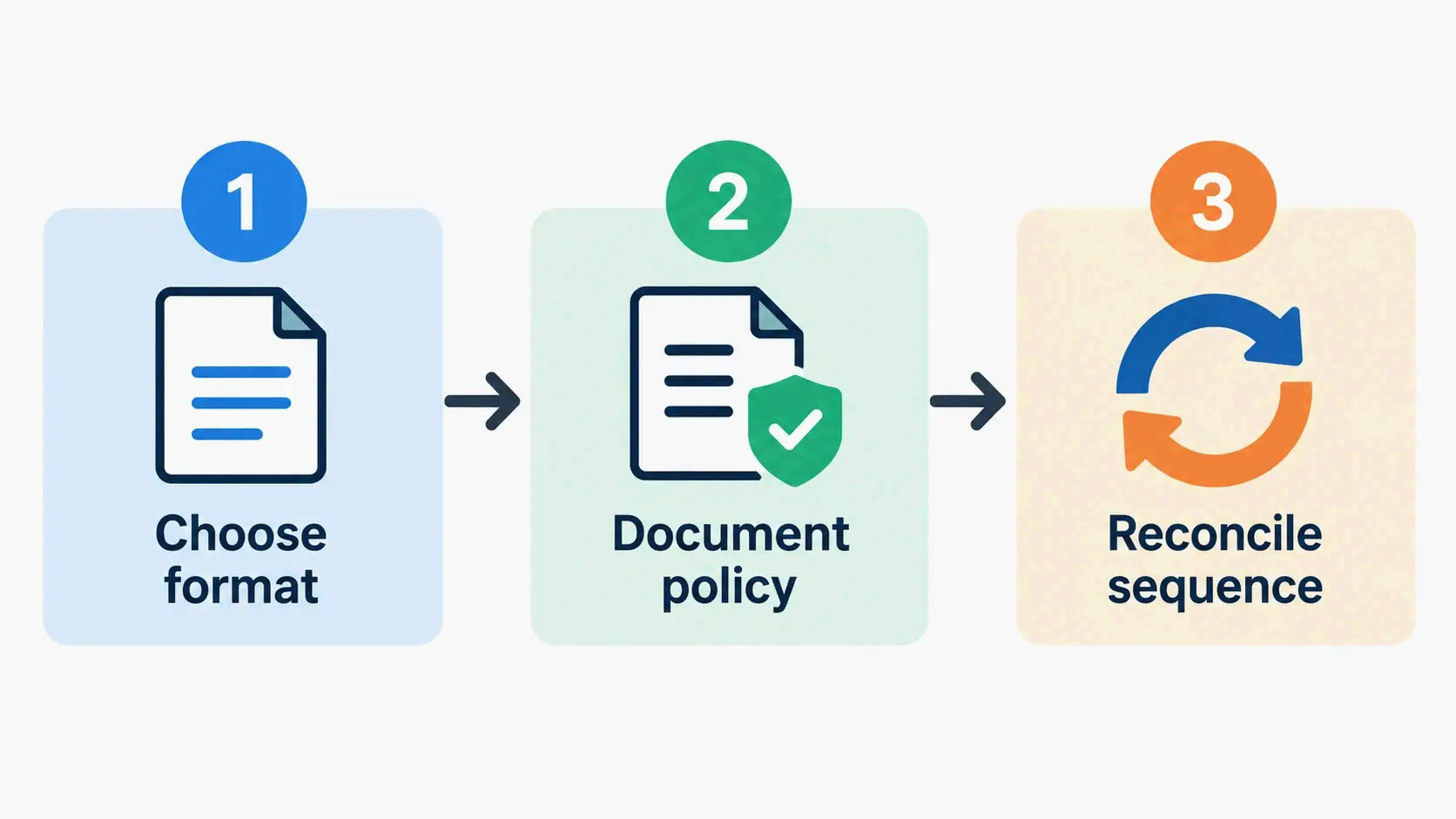
Step 1 — Choose your prefix. Use prefixes to distinguish document types: INV for sales invoices, CN for credit notes, PF for pro forma documents. Alaan recommends separate prefixes for invoices and credit notes specifically to avoid sequence contamination. If you operate multiple entities or branches, add a controlled entity code and make sure no two entities share it.
Step 2 — Set the sequence length and zero-padding. Work backward from your maximum expected invoice volume over the next three to five years, then pad to that width. Four digits (0001) covers up to 9,999 invoices per year; five digits covers 99,999. Choosing the width up front avoids the renumbering problem that appears when you outgrow a three-digit sequence in month eight.
Step 3 — Write down your reset policy. Decide whether the sequence resets at the start of the year or runs continuously forever. If it resets, decide how the reset avoids collisions with historical numbers — the common solution is to embed the year in the identifier rather than returning the running number to 0001. Record the policy in an accounting policy document rather than leaving it as tribal knowledge.
Step 4 — Document who assigns numbers and when. The assignment rule that matters most is timing: numbers should be generated when the invoice is issued, not when a draft is created. Alaan explains that assigning numbers at the draft stage leaves gaps behind when drafts are abandoned or edited. Lilach Bullock applies the same principle at the workflow level with her rule of invoicing within 24 hours of completion or milestone, which keeps the sequence order consistent with the order work was actually delivered.
Step 5 — Fix the template. Place the invoice number at the top of the document, next to the issue date and the customer’s details, and keep that position identical across every template version. Statrys notes that most invoicing software and standard templates already place it there by default, which makes it easy for a client to find when paying or asking a question.
Step 6 — Set a check point. Run a monthly reconciliation of your numbering sequence against your issued invoices. Look for duplicates and unexplained gaps while the month is still open. Alaan recommends periodic sequence reviews to confirm there are no unexplained gaps or duplicates, because early detection avoids painful corrections during an audit.
Where the Invoice Number Should Appear on the Document
The invoice number belongs near the top of the invoice, in the header block, close to the issue date and customer information. That placement lets a customer retype it accurately into a payment memo and lets an accounts team find it without scanning the whole document. Whatever template you use, the field label and position should stay consistent — InvoiceAtlas recommends keeping important identifiers together near the main invoice details, with the invoice number shown first, followed by the PO number or other reference, then the invoice date and due date.
How to Write an Annual Reset Policy (and When Not To Reset)
A workable reset policy answers four questions in writing: does the sequence reset, on what date, how does the new series avoid colliding with historical numbers, and where is the policy recorded? Alaan confirms that invoice numbers can restart at the beginning of a new financial year provided the reset is clearly documented and the sequence stays continuous within that year. The safer pattern for most US businesses is to embed the year in the identifier — INV-2026-0001 followed by INV-2027-0001 — rather than returning a bare running number to 0001, which risks two open invoices sharing a short reference. If you have open receivables spanning a year end, resetting is usually more trouble than it is worth; run a continuous sequence instead.
Changing Formats Mid-Year: Freeze Points and Migration Rules
Changing formats mid-year is one of the most reliable ways to break continuity. Alaan warns that format changes mid-period complicate reconciliation and reporting, and Tofu lists inconsistent formats as a direct cause of sorting errors when invoices stop following the established system.
If you need to change, set a freeze point — typically the start of a fiscal year or a new quarter — reconcile the old sequence completely before the switch, and never return to the old format. Historical invoices are not renumbered. HashMicro’s numbering guidance describes the migration sequence in practical terms: freeze the cutover point, reconcile open receivables, communicate the new format, and obtain approval for any exceptions before the first invoice leaves the new system.
Why Invoice Number Discipline Is a Cash Flow Lever, Not Just a Compliance Task
Numbering and invoice timing are two halves of the same cash flow mechanism. The invoice date starts the clock on your payment terms. The number is what lets the incoming payment be matched to the right invoice once it arrives. Together they determine how long your cash sits outside your account.
That second half is where the friction shows up. Payment memos are frequently incomplete or mistyped, and a unique, continuous invoice number is the one key that can still reconcile an imperfect payment. Statrys describes the consequence of not having one: tracking outstanding invoices and reconciling payments relies on memory or manual searching, and managing multiple invoices across several clients makes any gap in the sequence significantly harder to resolve.
The scale of the problem is well documented on the receivables side. According to the 2025 Intuit QuickBooks Small Business Late Payments Report, 56% of small businesses have late payments owed to them. On the more severe end, the European Commission’s Late Payment Directive work has estimated that non-payment and late payment of invoices cause 25% of corporate bankruptcies — a figure from a non-US regulatory context, included here as background on why collection timing has outsized consequences.
There is a first-person illustration of how much timing alone can cost. Lilach Bullock describes sending invoices a week or more after delivering work while on standard 30-day terms, which stretched what looked like a 30-day cycle to roughly 45 days from delivery to payment. Across five or six clients on rolling retainers, that produced a persistent cash gap of a few thousand pounds every month. The fix was a single rule — invoice within 24 hours of completion or milestone, no exceptions — which pulled almost two weeks back into the cash cycle without changing a single client’s payment terms.
The same discipline shows up on the service side. As Lev Tretyakov of Fortador USA notes, the invoice number “makes it easy to pull up the transaction and provide accurate assistance to our clients.” Both benefits come from the same underlying habit: a numbering system that stays in step with real business events.
Common Invoice Numbering Mistakes and How to Repair a Broken Sequence
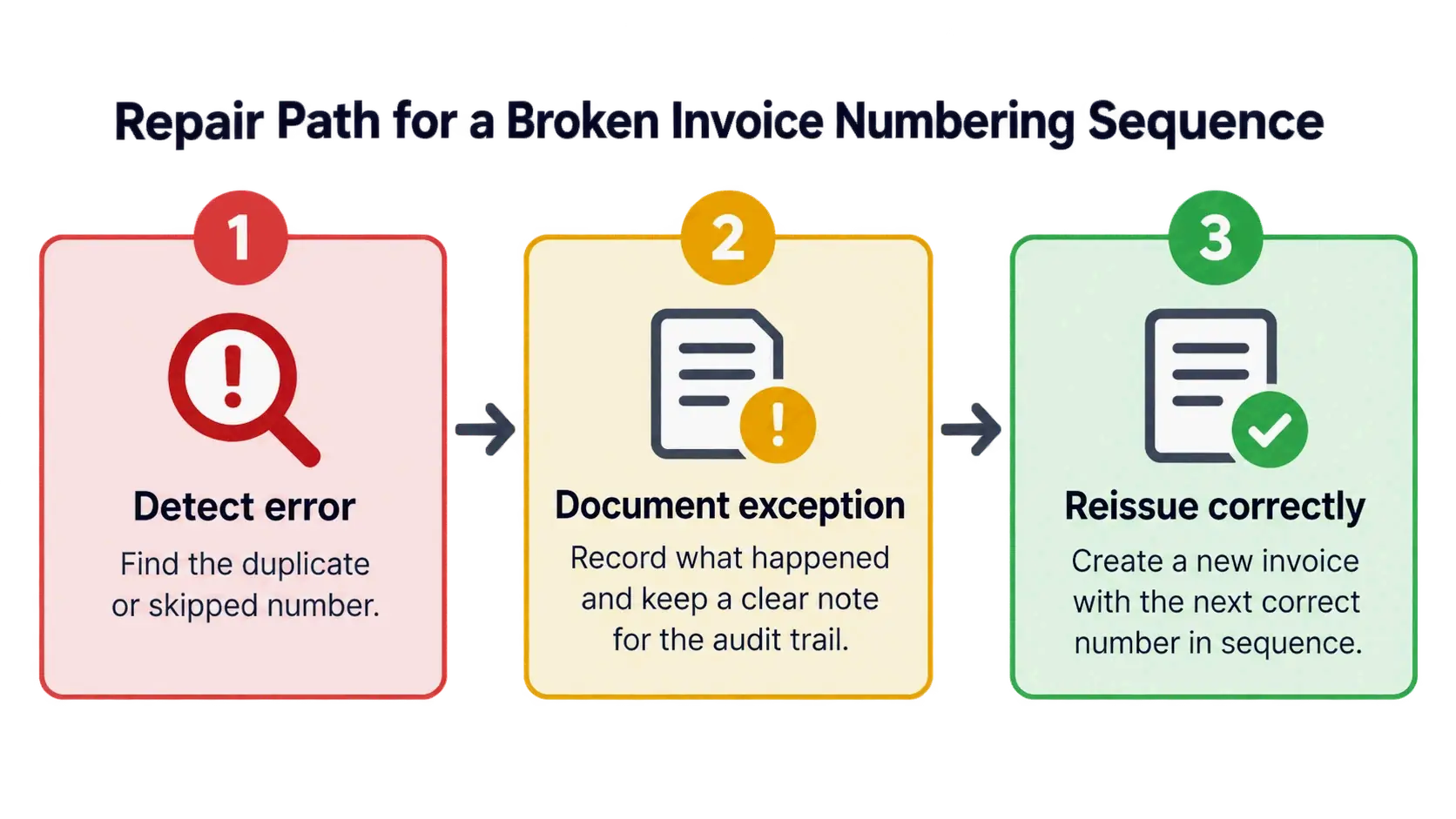
Most numbering failures fall into a short list: duplicate numbers, skipped numbers, deleted or edited numbers, voided invoices with no explanation, format changes mid-year, and multiple systems each generating their own numbers. Each has a documented repair path.
For context on how common invoicing errors are in general, a second-hand compilation cited by Tofu states that 39% of invoices contain errors. That figure is republished without a marked statistical year and should be treated as indicative only — it is useful for illustrating that invoicing errors are not rare, not for drawing conclusions about numbering accuracy.
I Found a Duplicate Invoice Number — Now What?
Do not delete either document. First confirm which of the two is the original issued invoice. Keep the original number as it stands. Void the duplicate and reissue the correct invoice under a new number. Note the original number and the reason for the void directly on the record, and retain the correction in your files. Statrys describes the equivalent workflow for a numbering mistake: mark the incorrect invoice as void and note the reason, then issue a corrected invoice with a new number, which keeps records complete and prevents gaps that could raise questions during an accounting review. Never reassign the duplicated number to a new document.
How to Document a Skipped Number Without Reusing It
A skipped number needs a written explanation, not a backfill. Do not issue a new invoice into the empty slot, and do not reuse the number for anything else. Instead, record the exception in a log with five fields: the number, the date, the reason (voided, never issued, or system error), the action taken, and the reviewer. HashMicro’s control framework treats missing exception logs as a distinct failure mode, because without one, finance cannot distinguish a legitimate exception from an error. Alaan makes the same point about voided invoices: leave voided numbers in the sequence with a documented reason so reviewers can see the run is complete.
Migrating from Excel to Invoicing Software Without Breaking the Sequence
Migration is where duplicate numbers most often appear, because a legacy spreadsheet and a new system can both be generating numbers for a short window. Fix it in order. Freeze the cutover point and stop issuing from the old system. Reconcile the old sequence completely, including any open receivables. Configure the new system’s starting number and format. Preserve legacy references in a separate field rather than overwriting them. Then test duplicate prevention before going live. HashMicro notes that legacy references should be preserved in a separate field when the new system key differs, because legacy and new sequences can collide after cutover.
Two related traps deserve specific mention. Credit notes and pro forma invoices must run in their own series; if they share the invoice sequence, they will look like duplicates of legitimate invoices. And when multiple systems generate numbers, designate one system of record for number generation and let the others sync rather than create.
Invoice Automation: How Software Removes Human Numbering Errors
Automation addresses numbering at the level where the errors actually originate. A system that generates the number at issuance enforces uniqueness by construction, blocks a duplicate before it posts, and holds the sequence intact when several people issue invoices concurrently. Alaan describes automated systems as ensuring numbers are assigned once and only once, sequences remain intact across users and departments, and the same number flows into accounting tools and reports.
Three error classes largely disappear with automation: manual duplicates, format drift between team members, and skipped or never-issued numbers caused by draft-stage assignment. What remains is a different set of exceptions — data migration leftovers, multiple entities sharing a sequence they should not share, and manual overrides of system-generated numbers. Those are governance problems, not software problems, and they need policy rather than a feature.
Buyer-side cost is worth understanding too, because it explains why large customers care how you number. HashMicro cites Ardent Partners’ 2025 global benchmark, which reported a 22% average invoice exception rate — a figure that shows how often invoices fail to process cleanly on the receiving end. Inconsistent or ambiguous references contribute to that failure rate, which is why enterprise AP teams often require a valid PO number and a clear invoice number on every document they receive.
What to Look For in Invoicing Software
Evaluate numbering capability with specific questions rather than a feature tour. Does the system support custom prefixes and zero-padded sequences without manual formatting? Can it share a sequence across entities, or isolate one per entity where that is required? Does it detect duplicates at entry rather than at month-end? Does it keep an audit history showing who issued, voided, or changed a number, and does it prevent edits to issued references? HashMicro recommends restricting manual edits, deletion, backdating, and sequence changes through role-based access, and testing the full workflow — including a duplicate attempt the system must reject and a cancelled document whose reference never returns — before committing to a vendor.
Invoice Numbers in E-Invoicing Standards
If you ever exchange invoices in structured electronic formats, the invoice number becomes a data field with defined transmission rules rather than a visible label. Wikipedia’s overview of invoicing notes that the United Nations EDIFACT “INVOIC” standard includes standard codes for transmitting header information common to the entire invoice as well as line-item detail, and can also carry credit and debit memos. XML-based standards include the UN/CEFACT cross industry invoice and OASIS Universal Business Language (UBL), which is used in public-sector implementations including Denmark, with further implementations in Italy, Spain, and the Netherlands, and the PEPPOL framework for European public procurement. ISDOC was developed in the Czech Republic as a universal electronic invoice format.
There is also a process model that bypasses invoices altogether for some transactions. Evaluated Receipt Settlement (ERS) pays from the packing slip rather than a separate invoice: the supplier ships against an advance shipping notice, and the purchaser confirms the corresponding purchase order or contract, verifies the goods, and pays. If your customers use ERS, your internal numbering still governs your own records even though no invoice number travels with the payment. Because public documentation on e-invoicing standards ages quickly, verify current requirements against the standards body or your customer’s specification rather than a secondary summary.
Conclusion
Invoice numbering is an internal control, not a formatting preference. A unique, continuous, explainable sequence makes payment matching faster and audit questions rarer — and in the US, the real constraint is not the format but whether your records can be traced and reconciled. Three actions to take today: write down your format and reset policy, including prefixes and zero-padding; pin the invoice number to the top of every template and commit to invoicing within 24 hours of completion or milestone; then run one continuity reconciliation and log every existing duplicate and gap in an exception file.
FAQ
Does the IRS require invoice numbers on invoices?
No. There is no federal requirement for invoice number format or continuity. However, IRS Publication 334 requires businesses to keep records supporting income and expenses, and invoice numbers are what let those records cross-reference each other. Some state sales tax rules impose additional invoice field requirements, so check the rules for states where you operate.
Can I reset my invoice numbers at the start of a new tax year?
Yes, but there is no single mandatory US rule — what matters is writing the policy down and applying it consistently. Alaan notes that a reset is acceptable when clearly documented and the sequence stays continuous within the year. A safer pattern for most businesses is embedding the year in the identifier, such as INV-2026-0001, rather than returning the running number to 0001 and risking collisions with open historical invoices.
What should I do if I skip or duplicate an invoice number?
For a duplicate, confirm the original, void the duplicate, and reissue under a new number while recording the original number and reason. For a skip, do not backfill or reuse the number — document it in an exception log with the date, reason, and reviewer. Both cases need a written trail so the sequence stays explainable during any review.
Is an invoice number the same as a receipt number?
No. An invoice number identifies a request for payment; a receipt number identifies confirmation that payment was received. Statrys describes them as different document types serving different purposes that both belong in your recordkeeping system. Many systems generate the receipt number separately, so store them in distinct fields.
Can two different suppliers use the same invoice number?
Yes. Uniqueness is only required within a single issuing entity — Alaan confirms invoice numbers only need to be unique per supplier, not across different businesses. That is why buyer systems typically identify an invoice using the combination of supplier plus invoice number, and why enterprise customers require your business identifier and invoice number to appear together.
Where should the invoice number appear on an invoice?
Place it in the header, near the invoice date and the customer’s details. Statrys notes that most invoicing software and standard templates position it there by default, which makes it easy for a client to locate when paying. Keep the field label and position identical across every template version you use.
Leave a Reply